The real issue is the customer experience.
For years, contact centres have primarily been evaluated using operational metrics such as average handling time, service level, cost per interaction, and occupancy rate. These indicators remain important, but customer expectations have evolved.
Consumers want to get answers quickly, regardless of the channel they use. They expect agents to know their history and to resolve their issue without transferring them from one department to another.
This is where artificial intelligence can have the greatest impact: not by replacing agents, but by giving them access to the right information at the right time.
An agent who has to navigate between multiple applications to answer a question about a service renewal, a refund, or a contract change loses valuable time. With AI, the relevant information can be presented in real time, directly during the conversation.
The result is not limited to productivity gains. It also creates a smoother experience for the customer and reduces the effort required from the agent.
AI capabilities are advancing rapidly. Processes, roles, and work habits, however, evolve at a different pace. This is why change management remains one of the main factors in successful adoption.
Every wave of technology in contact centres has raised concerns: CRM systems, web self-service, cloud computing, digital channels and, more recently, hybrid work. Artificial intelligence is no exception.
Some agents are concerned that their role may become less relevant. Others see these tools as a form of increased monitoring. Supervisors must also learn how to manage teams whose work is increasingly supported by AI.
Gartner’s roadmap therefore reinforces an essential point: AI adoption is first and foremost a human initiative. Training employees, clearly communicating objectives, explaining the expected benefits, and involving teams in the evolution of processes are just as important as selecting the technology.
Organizations that overlook this aspect risk seeing their investments deliver far less value than expected.
No artificial intelligence platform can be better than the data and content it uses. Yet in many contact centres, knowledge bases are incomplete, information is spread across multiple systems, and documentation practices lack consistency.
When an AI solution provides an incorrect answer, the root cause is often upstream: outdated documentation, missing data, or contradictory content.
Organizations that achieve the best results therefore invest just as much in data and knowledge governance as they do in technology platforms. The quality of tomorrow’s customer experience will depend largely on the quality of the information available today.
The contact centre of tomorrow is unlikely to be fully automated. The most complex interactions will continue to require judgment, a deep understanding of context, and an ability to adapt that people bring to the customer relationship.
What will change is the way agents perform their work. The highest-performing contact centres will not be those that have replaced the greatest number of people with algorithms. They will be the ones that have created effective collaboration between people and artificial intelligence.
Agents will have better tools. Supervisors will have access to deeper insights. Managers will make better-informed decisions. And customers will benefit from more seamless and personalized experiences.
For contact centres, artificial intelligence represents much more than a feature to add to an existing platform. It provides an opportunity to rethink the customer experience, simplify agents’ work, and improve operational performance over the long term.
However, the organizations that achieve the best results are not necessarily those that invest the fastest in new technologies. They are the ones that define a clear vision, prioritize the right use cases, prepare their data, and engage their teams.
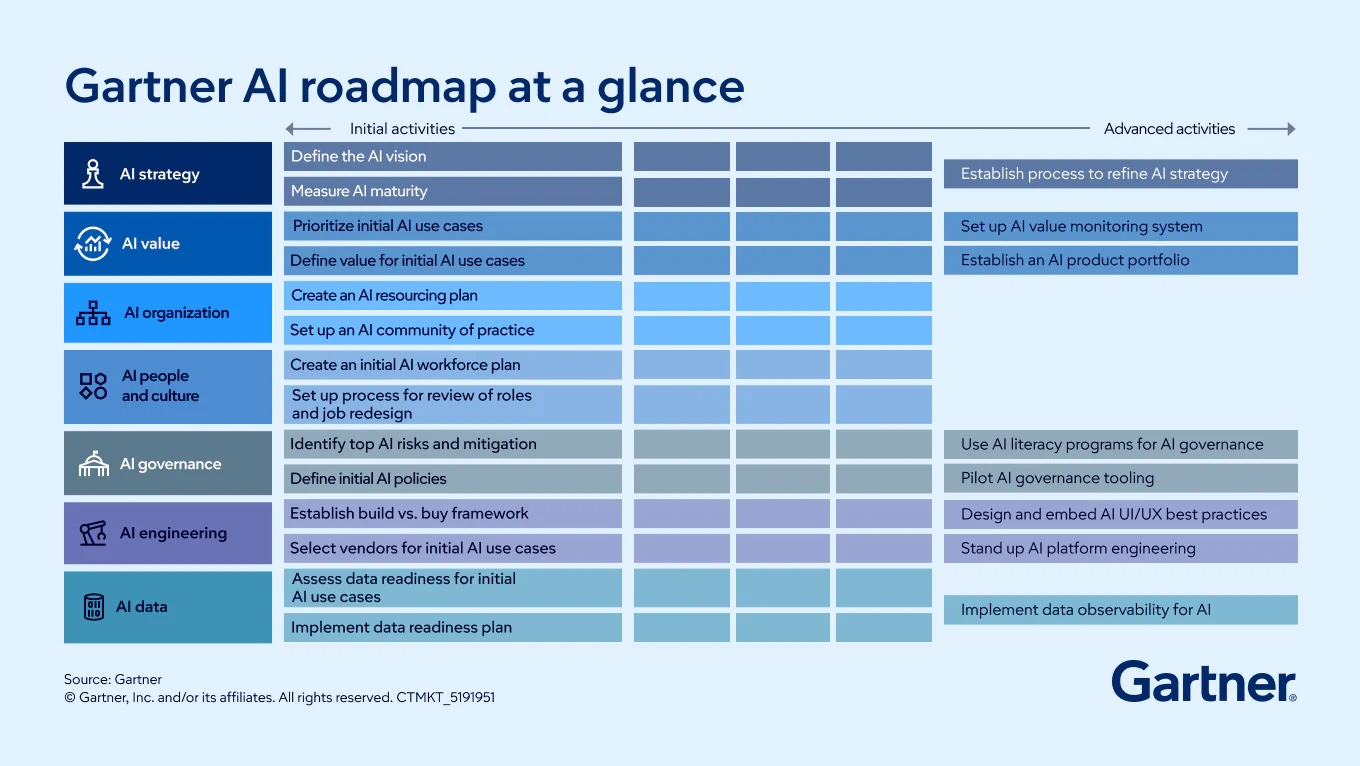
This is the central idea behind Gartner’s roadmap: AI is not an isolated technology project. It is a transformation program that touches strategy, value, the organization, people, governance, engineering, and data.
At Oxilio, we see this challenge every day in the contact centres we support. Whether it involves assessing an organization’s maturity, identifying high-value use cases, optimizing a NICE CXone environment, deploying generative AI capabilities, or integrating advanced conversational assistants, success rarely depends on technology alone.
Our role is to help organizations connect the possibilities offered by artificial intelligence with the operational realities of their contact centre. With our expertise in CCaaS, customer experience, and intelligent automation, we support our clients at every stage of their journey, from defining the strategy to implementation and then ongoing optimization.
Ultimately, the goal is not to have more AI. It is to use it more effectively to provide a better customer experience, make employees’ work easier, and improve the organization’s performance.